
How long can you hold your breath underwater?
CA-EBS and Offshore Helicopters: An Introduction
Safety has always been top of the agenda for all industries, including those that heavily rely on helicopter transportation. A lot of consultations and policy work has happened in the UK/Europe to bring in advanced safety devices for such risky commutes. One such introduction has been the Compressed Air Emergency Breathing System (CA-EBS). This system greatly improves the chances of survival compared to the air pocket re-breather, also known as an Emergency Breathing System (EBS). Historically offshore helicopter travel in Australia has relied on the passenger’s ability to deploy their air pocket re-breather system before submersion or purely holding their breath. The CA-EBS can be deployed quickly, easily with one hand-purge, breathing off the unit while stationary and moving underwater.
Improving Survival Rates
Impact injury is the main primary cause of fatality in uncontrolled water impact accidents, whereas it is drowning in the instance of potentially survivable water impact. The book ‘Handbook of Offshore Helicopter Transport Safety’ reports on the accident near Cormorant Alpha platform in the North Sea. The book comments on the ability of the occupants to take a breath of air before head submersion when water ingress was rapid. Occupants who were at the front didn’t survive, and those at the rear had a chance to take a deep breath (AAIB, p.28). It highlights the fact that an EBS could minimize fatalities. The impact of low water temperature in reducing breath-hold time considerably is also an important factor.
CA-EBS is believed to improve survival rates. During a submersion, a helicopter can go straight down from 100mph to 0mph in a matter of seconds. Research shows that provision of an underwater breathing device gives adequate time to act appropriately (Ryack et al.,1986, p.608).
It is safe to assume even if the re-surfacing happens from depth with a CA-EBS, survivability factor increases vs. not having a suitable breathing device to survive underwater.
The CA-EBS is also believed to reduce the sense of urgency vs., breath-holding and re-breather, which in turn minimizes the difficulty and less cognitive loading. These findings are recorded in research (The effect of emergency breathing systems during helicopter underwater escape training for land force troops) conducted with Canadian troops in a simulated HUET training. Out of the participants 58% successfully escaped to the surface and 100% managed with a CA- EBS. (McCabe et al.,2009).
Importance of Training
Proper training is essential as it facilitates understanding the nuances of the gear. The potential risks of deploying CA-EBS underwaters, such as decompression sickness and lung inflation should be considered.
These risks can be mitigated through robust and in-water training, allowing the user to deploy with ease and with speed. OPITO recognises the importance of practical hands-on training. In the interest of helicopter safety they’ve recently introduced practical CA-EBS in water activities. These activites are now an option throughout the FOET, TFOET, BOSIET and TBOSIET courses. The CA-EBS in-water activities now allow the user to deploy with both hands, purge and breathe off the CA-EBS system while underwater.
Improvements For a Safer Future
This introduction of the in-water CA-EBS exercises could be seen as nothing but a positive step in the right direction for improving the safety of men and women who travel by helicopter to work every day. Since 2009, six helicopter accidents have occurred that resulted in 33 deaths and needed 65 others rescued. We all should work together to keep striving for best in class safety for those who put their lives in great danger.
What is a HUET?
A Helicopter Underwater Escape Training (HUET) is a course that prepares personnel with the knowledge and skill to safely disembark from a helicopter that has made an emergency landing or ditched on to water.
Is a HUET the same as an OPITO BOSIET / TBOSIET / FOET / TFOET?
No, a HUET is commonly confused with an OPITO TBOSIET, BOSIET, FOET or TFOET. The courses vary in the content they deliver, their regulators, the intended participant and where they are recognised (national vs international).
The OPITO courses encompass the HUET learning outcome as well as a wider range of topics. These topics include safety induction (T BOSIET & BOSIET only), firefighting, self-rescue, sea survival and first aid. They are regulated by OPITO, which is an international not for profit Oil & Gas industry-owned organisation. The TBOSIET, BOSIET, FOET and TFOET courses are internationally recognised as the primary requirement to work offshore in the Oil & Gas industry.
To learn more about these courses please follow the links below:
BOSIET | BOSIET with CA EBS | TBOSIET | FOET | FOET with CA EBS | TFOET
Two of the four HUET courses discussed in this article are delivered to Nationally Recognised Training (NRT) standards and only recognised in Australia. The remaining two are the internationally recognised OPITO Tropical Helicopter Safety & Escape course (OPITO THUET) and OPITO HUET. These courses only deliver HUET related learning outcomes and are designed for a range of industries and personnel (as described later in this article).
So if I have an OPITO BOSIET / TBOSIET / FOET / TFOET, do I need a HUET?
It is very rare that personnel holding a valid OPITO BOSIET / TBOSIET / FOET / TFOET will need to also complete an additional HUET course. In an instance where it is required this would be advised by an employer or facility operator.
If the participant has been granted dispensation from attending the full BOSIET/TBOSIET (typically if they are only visiting an offshore facility for a short time) a HUET delivering a NRT competency or OPITO THUET course may be required. This is not a common occurrence. Please note that the offshore facility operator will inform individuals that this qualification will be acceptable.
What’s involved in a HUET course?
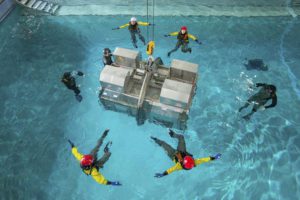
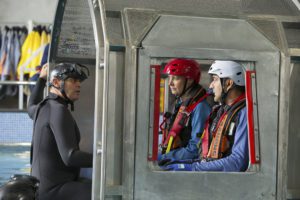
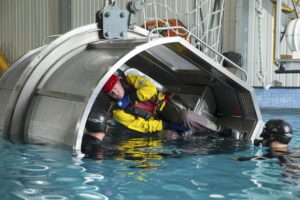
A HUET course combines practical exercises with learning about such topics as; helicopter safety, emergency procedures, underwater escape techniques and sea survival. The practical elements are conducted in a pool utilising a specially designed HUET module and life raft. The HUET module represents the cabin of a helicopter and has the ability to rotate at least 180 degrees while being submerged in water to simulate a helicopter ditching resulting in capsize. While in the module participants put into practice such skills as brace positions, escape plans and the operation of emergency exits.
Who needs to complete a HUET course?
If you travel regularly by helicopter over water for your work in Australia you may be required to complete a HUET course. These courses are designed for specific environments, situations, industries and job roles; these are described for each course below. As mentioned previously, if you hold a valid OPITO BOSIET / TBOSIET / FOET / TFOET it is unlikely you will also have to complete a HUET course.
What are the different types of HUET courses?
There are three different “HUET” courses delivered by ERGT Australia (RTO 2534) which have been designed by industry and regulators for different roles and industries. These courses are:
Helicopter Underwater Safety & Escape Training (HUET)
This course is designed for personnel travelling regularly by helicopter to any of the following installations or facilities; offshore rig/installation, floating facility, or support vessel. It delivers the NRT certification PMAWHS214 Undertake helicopter safety and escape. This course delivers such content as; prepare for flight, prepare for helicopter ditching and undertake evacuation from helicopter but does not include the use of an Emergency Breathing System (EBS).
Aircraft Underwater Escape & Survival for the Aviation Industry (AVI AUES)
This course has been designed for Pilots and Flight Crew across a range of industries including; emergency services, law enforcement and military. The AVIF0038 Undertake aircraft underwater escape and survival NRT unit can be delivered in conjunction with AVIF0039 Utilise emergency breathing system, which enables the participants to gain confidence utilising an EBS during an emergency landing or ditching on to water. Both of these AVI competencies can be delivered separately if one is not required.
OPITO Tropical Helicopter Underwater Escape Training (Standard Code 5195)
This course delivers OPITO THUET and has been designed for those travelling to Oil & Gas installations/facilities via helicopter in a tropical environment. It contains helicopter safety and escape, facility abandonment via a life boat (TEMPSC) and sea survival.
OPITO Helicopter Underwater Safety & Escape Training (Standard Code 5095)
This course is a cold water qualification. It has been designed for workers with special exemptions (such as for a one day trip) travelling in cold water environment to Oil & Gas installations/facilities via helicopter. This course delivers the HUET and Sea Survival component of the BOSIET and FOET courses.
All of these one day courses require a valid HUET medical or equivalent in order to undertake training.
Where can I complete any of the HUET courses you’ve described?
All of these courses need to be delivered at a training centre with a HUET module, or a suitable location at which a mobile HUET can be operated. ERGT has three centre-based HUET modules located in Jandakot (WA), Darwin (NT), and Altona (VIC). All three centres also deliver the OPITO BOSIET, TBOSIET, FOET and TFOET.
Acronyms:
BOSIET – Basic Offshore Safety Induction & Emergency Training
TBOSIET – Tropical Basic Offshore Safety Induction & Emergency Training
FOET – Further Offshore Emergency Training
TFOET – Tropical Further Offshore Emergency Training
HUET – Helicopter Underwater Escape Training
THUET – Tropical Helicopter Underwater Escape Training
NRT – Nationally Recognised Training
TEMPSC – Totally Enclosed Motor Propelled Survival Craft
CA EBS – Compressed Air Emergency Breathing System
EBS – Emergency Breathing System
NRT – Nationally Recognised Training
RTO – Registered Training Organisation
As many Australia operators, and their service providers, settle into steady-state operations the workforce is entering a different requirement for skill development. Under these more stable circumstances, it is vitally important to maintain a focus on safety and the prevention of major accident events. We need to ensure that the workforce capability remains current and continues to address the needs of the market in relevant in a steady-state environment.
ERGT continues to provide Nationally Recognised Training to a standard of quality and rigour that we deem to be vitally important.
Our purpose is to keep people safe in a hazardous workplace, so there is no room for compromise.
Currently our industry competency frameworks ensure that we maintain the level of capability equivalent to that required of an industry entrant. There is less emphasis or requirement to cater for those experienced operators in the industry and hence a greater potential for this workforce to neglect the messages in their ongoing training that may become a “tick & flick” exercise.
1-3-7-12 Weeks
“Staggered and varying deliberate practice over a range of weeks will embed learning and assist retention of critical elements” (Driscoll, Hagman)
Meeting Industry Capability Needs
Industry employees are required to maintain their skills over an extended career in a steady-state environment and ERGT has considered how best to address the needs of this experienced group. ERGT has designed training to appeal to those more experienced employees with courses that include through a variety of experiences in a broader range of workplace contexts. We will provide different learning experiences each time an employee returns for skills maintenance training. It will no longer be more of the same training over and over, but an opportunity to reinforce current skills and broaden capability over time – a well-researched learning strategy for skill retention.
…the similarity of the training (acquisition) and work (retention) environments plays a major role in the retention of skills and knowledge over periods of non use or non practice… (Arthur, Bennett, Stanush & McNelly)
Skill Retention
Industry regulators drive safety practices in many ways. One way is to ensure that operators maintain a level of training to avoid skills declining over time. After 365 days there is substantial skill loss with non-practice or non-use. (Shute/Gatwick)
Hence, in high risk industries, where our ability to practice on the job is limited, it is essential that the learning environment is closely related to the work context so transference of learning and retention of skills can be most effective. ERGT has designed our facilities to replicate the workplace. Our ‘platform’ allows us to create an immersive training experience that cannot be created in a training room. Our scenario-based training methodology creates a virtual environment that lectures, power points and a picture can’t mimic.

“Decay is mostly represented as a degraded process when there is no follow-up training, drills and exercises or use of the new skill. It begins almost immediately.” (Winifred)
50-75%
“Skill decay is greatly reduced when learning takes place in a realistic simulated workplace.” (Barclay et al.)
How We Can Support High-Risk Industries
To ensure the workforce acquires and maintains the skills needed over periods of non-use or non-practice ERGT provides a safe and realistic learning environment where trainees can be assured their competence is reviewed and re-assessed on a regular basis but without repetition. We partner with organisations and individuals to ensure that skills required and application of learning replicates the workplace context closely. The more realistic the learning, the more likely the application in the workplace will lead to a safer industry.

>80%
“For critical skills such as Incident Command for OIM’s it would not be appropriate to fall below an 80% skill level.” (NOPSEMA)
The Australian Maritime Safety Authority have issued Marine Notice 7/2016 reminding vessel owners, operators, masters, officers, ratings seafarer training organisations, coastal pilots and industry organisations that Certificate of Safety Training issued with no expiry will expire after 31st December 2016.
Have a read here for the full Marine Notice.
Return to top